Your phone rings while you are with a client.
You cannot answer, so you let it go to voicemail.
No message.
You tell yourself that if it was important, they will call back.
They probably will.
Just not necessarily to you.
When someone calls a service business, they are often ready to ask a question, check availability, or solve a problem now. If they get silence, calling the next business on the list is not unreasonable. It is efficient.
That is why a missed-call text-back automation is one of the simplest systems you can add—and one of the easiest for a potential client to understand.
It does not require a complicated funnel. It does not pretend software can replace a real conversation. It simply makes sure a missed call does not become a dead end.
What is missed-call text-back automation?
A missed-call text-back automation sends a text message when your business receives a call that nobody answers.
The message usually acknowledges the missed call, identifies the business, and gives the caller an easy next step. They can reply by text, book an appointment, or wait for your return call with some confidence that their inquiry did not disappear into the void.
A basic message might say:
Hi! This is Kieffer Media. Sorry I missed your call. How can I help? You can reply here, and I’ll get back to you as soon as I can.
That is it.
No dramatic chatbot introduction. No seven-paragraph explanation of your brand values. Just a useful response at the moment it matters.
Why missed calls become lost leads
Businesses tend to think of a missed call as a small inconvenience.
The caller experiences it differently.
They do not know that you were helping another client, driving between appointments, or taking the first uninterrupted lunch break you have seen since Tuesday. They only know that they called and could not reach anyone.
If the need feels urgent—or if they are comparing several providers—they may keep moving.
This is the same momentum problem behind why leads go cold after showing genuine interest. The longer the gap between action and response, the more room there is for distraction, doubt, or a faster competitor.
A missed-call text-back closes that gap without requiring you to be permanently attached to your phone.
How a missed-call text-back workflow works
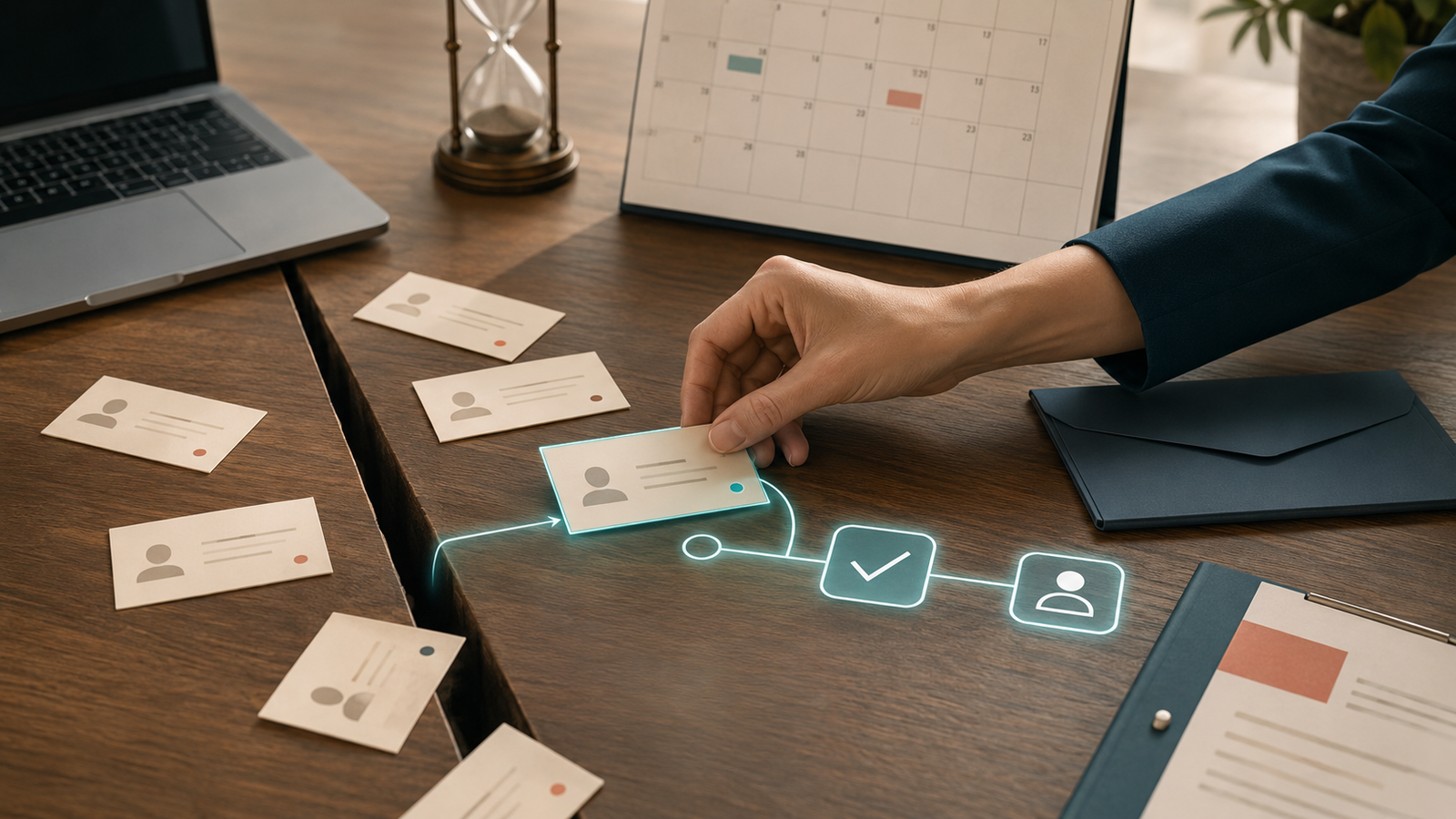
The workflow is straightforward:
- A call comes in. Your business line rings as usual.
- The call is missed. Nobody answers within the time or conditions you set.
- The system sends a text. The caller receives a short acknowledgment from your business number.
- The contact is captured. The phone number is created or updated in your CRM.
- Your team is notified. You know a missed caller may be replying by text.
- The caller takes the next step. They reply, use a booking link, leave details, or wait for your return call.
- Automation gets out of the way. Once a conversation starts, irrelevant follow-up messages stop.
That last step matters.
Automation should create the handoff, not keep barging into the conversation after a human has taken over.
This is one of the seven core workflows covered in 7 Marketing Automations Every Service Business Needs. It deserves its own article because phone leads behave differently from form submissions. They are often more immediate, less patient, and harder to track if you do not have a system behind the call.
What should a missed-call text say?
A strong missed-call text should be short, clear, and easy to answer.
Include:
- Your business name
- Acknowledgment that you missed the call
- A simple question or next step
- A realistic expectation for a response
- A booking link only when it genuinely helps
The goal is not to close the entire sale by text.
The goal is to keep the conversation alive.
General service-business example
Hi! This is [Business Name]. Sorry we missed your call. How can we help? Reply here with a few details, and someone will get back to you shortly.
Appointment-based business example
Hi! This is [Business Name]. We could not answer your call, but we would be happy to help. You can reply here or choose an appointment time at [link].
Consultant or coach example
Hi! This is [Name] from [Business Name]. I’m sorry I missed your call. Tell me a little about what you are looking for, and I’ll point you toward the best next step.
After-hours example
Thanks for calling [Business Name]. We are currently closed, but we received your call. Reply with your name and what you need help with, and we will follow up during business hours.
Notice what these messages do not do: overpromise.
If nobody will respond until morning, say that. “We’ll get right back to you” is not reassuring when “right back” secretly means tomorrow afternoon.
Should you include a booking link?
Sometimes.
A booking link is useful when the natural next step is clear: schedule a consultation, reserve an appointment, or choose a callback time.
It is less useful when the caller may need urgent assistance, a quick answer, an estimate, or help deciding which service applies.
Do not force every caller through the same scheduling link because the software made it convenient.
For many businesses, the best message gives two options:
- Reply with a few details
- Book a time if they are ready
That lets high-intent leads move forward while giving uncertain callers a lower-friction way to begin.
Who benefits most from missed-call text-back?
This automation is especially useful for businesses where phone calls represent active buying intent.
Local service businesses
HVAC companies, plumbers, electricians, roofers, cleaners, landscapers, auto-repair shops, and similar businesses often receive calls from people trying to solve a specific problem. A text-back can capture the request and location before the caller moves on.
Appointment-based businesses
Dentists, chiropractors, med spas, salons, wellness practices, insurance agents, and consultants can use the message to answer basic questions or direct callers toward scheduling.
Small teams and owner-operated businesses
If you are the person delivering the service and answering the phone, missed calls are inevitable. The automation gives you coverage without requiring a receptionist or interrupting every client interaction.
Businesses receiving after-hours calls
A clear after-hours response prevents uncertainty and collects enough information for a useful follow-up the next business day.
Not every missed caller will respond. That is fine. The system is not magic. It simply recovers opportunities that silence would have lost automatically.
Common missed-call text-back mistakes
1. Making the message sound robotic
“Your call is important to us” has been emotionally exhausted by hold music.
Write like a person. Identify the business, acknowledge the missed call, and ask how you can help.
2. Sending too many messages
A missed call does not justify an aggressive text sequence.
Start with one useful response. If the caller replies, continue the conversation appropriately. If they do not, one light follow-up may make sense for some businesses. Five increasingly dramatic reminders do not.
3. Treating the reply as permission for unrelated marketing
A missed-call response should address the person’s inquiry. It should not quietly enroll them in every promotional campaign you plan to send until retirement.
Automated business texting is subject to consent and opt-out requirements. Configure your system to honor requests to stop messages and get qualified legal guidance for your specific use. The FCC’s guidance on unwanted calls and texts makes clear that consumers can revoke consent through reasonable means.
4. Failing to notify a human
The automation opened the door. Someone still needs to walk through it.
If replies sit unseen in a shared inbox, you have moved the revenue leak rather than fixed it.
5. Letting automation continue after someone responds
Once the caller replies, books, or speaks with your team, generic messages should stop or change. Nothing undermines confidence faster than receiving “We still haven’t heard from you” in the middle of an active conversation.
6. Tracking nothing
If you cannot see how many missed calls received a text, replied, booked, or became customers, you cannot tell whether the workflow is doing its job.
How this fits into your larger follow-up system
Missed-call text-back solves one specific gap. It should still connect to the rest of your process.
When a caller replies, your system can:
- Create or update the CRM contact
- Tag the source as a missed call
- Record the conversation
- Assign the lead to the correct person
- Create a follow-up task
- Move the contact into the right pipeline stage
- Trigger appointment reminders if they book
This is where the automation becomes more than a polite text. It turns an anonymous missed call into a visible opportunity with an owner and next step.
The same principle applies to website inquiries. As explained in the contact-form follow-up workflow, capturing interest is only the beginning. The value comes from what the system does next.
For a broader explanation of pipelines, lead stages, and connected workflows, read CRM Automation for Service Businesses.
What should you measure?
You do not need a dashboard that looks like mission control.
Start with:
- Number of missed calls
- Number of text messages successfully sent
- Reply rate
- Appointments booked from missed calls
- Time from reply to human response
- Leads or sales recovered
Those numbers tell you whether the system is creating conversations and whether your human follow-up is keeping up.
If replies are high but bookings are low, the message may not make the next step clear. If the system sends texts but few people respond, review the wording, timing, and caller experience. If people reply and then wait hours for a human response, the automation is working—the handoff is not.
The bottom line
You will miss calls.
That is not a character flaw. It is what happens when you run a real business and occasionally do the work people are calling to hire you for.
The problem is allowing those missed calls to disappear without acknowledgment, context, or a next step.
A missed-call text-back automation gives the caller an immediate way to continue. It gives you time to respond thoughtfully. And it turns an easy-to-miss moment into a trackable conversation.
One small system.
One fewer place for good leads to vanish.
Frequently asked questions
What is an automated missed-call text?
It is a text message triggered when a business phone call goes unanswered. The message acknowledges the call and gives the caller a way to reply, book, or provide details while waiting for a return call.
How quickly should the missed-call text be sent?
It should arrive soon enough to feel connected to the call. The exact timing depends on your phone setup, but avoid long delays that make the caller wonder why they are receiving the message.
Should every missed call receive an automated text?
Not necessarily. Configure rules for repeat calls, known spam, landlines, existing conversations, and calls that were answered elsewhere. The workflow should help real callers without creating duplicate or irrelevant messages.
Can a missed-call text include a booking link?
Yes, when booking is the logical next step. Give callers the option to reply as well, especially when they may need a question answered before scheduling.
Does missed-call text-back replace returning the call?
No. It acknowledges the inquiry and keeps the conversation open. A human still needs to return the call or respond when the situation requires personal help.
Kieffer Media builds missed-call text-back, CRM, and automated follow-up systems for service businesses that are tired of losing leads simply because nobody could answer at the right moment. If missed calls currently disappear into voicemail and good intentions, let’s build a better next step.