You got the inquiry. They filled out your form, or messaged your page, or called and left a voicemail. They were interested — genuinely, provably interested.
And then… nothing. You replied a day later and got silence. Or you meant to reply and it slipped to the bottom of the list. Either way, someone who raised their hand quietly put it back down.
If that stings a little, good — it means you already know this is where revenue is leaking. What most business owners get wrong is why it happens. It’s not because your marketing isn’t good enough. It’s not because you need more leads to make up for the ones that vanish. Let’s fix the actual problem.
Why do leads go cold?
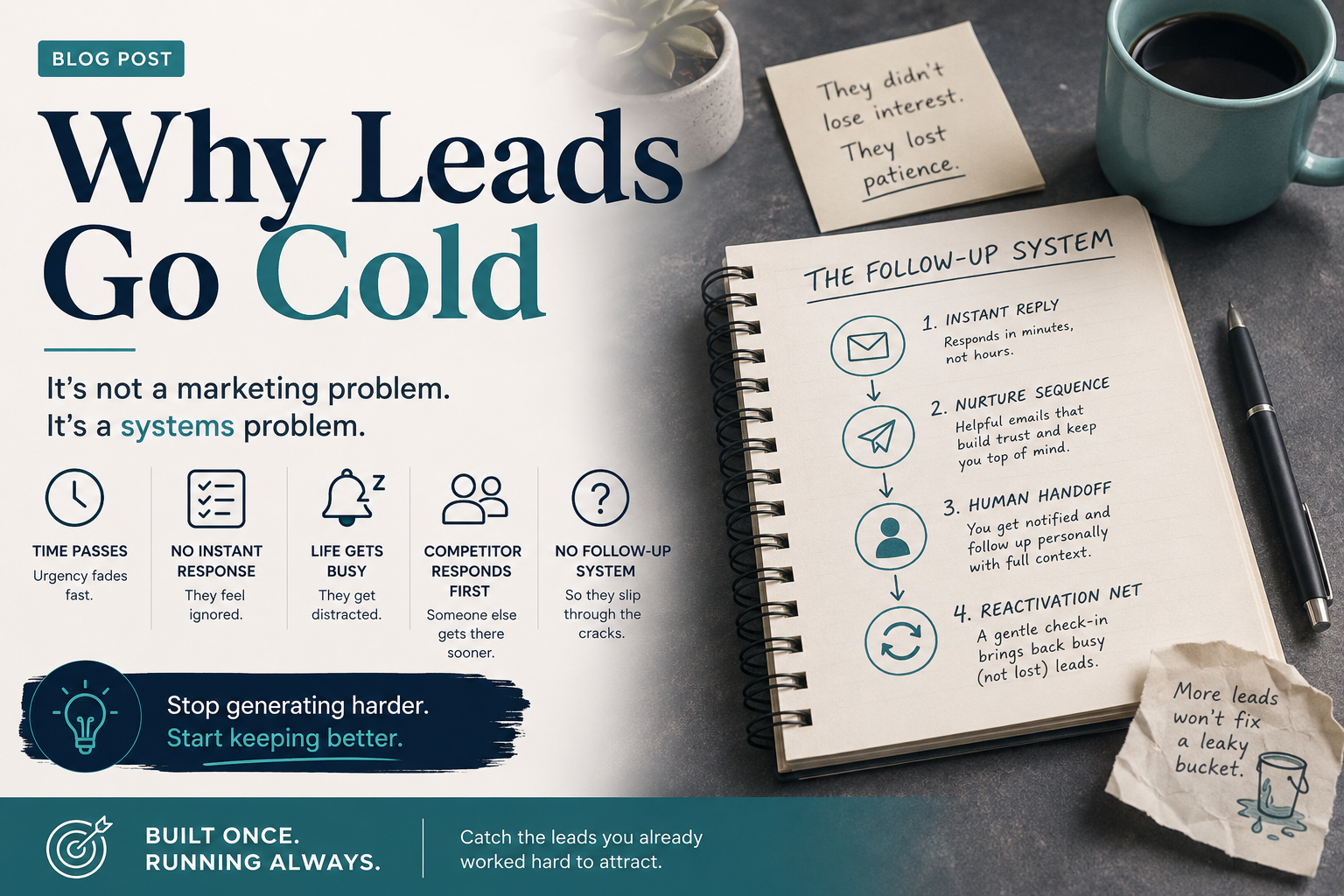
Leads go cold because of time, not disinterest. In the moment someone reaches out, their motivation is at its peak — they have the problem in front of them and you in mind. Every hour that passes after that, life crowds back in: they get busy, the urgency fades, or a competitor answers first. Most “lost” leads didn’t reject you. They just stopped waiting.
This is the part nobody tells you: the lead didn’t change their mind about needing help. They changed their mind about waiting for yours.
And that distinction matters, because it completely changes what you should fix. If leads were going cold because your offer was wrong, you’d need better marketing. But they’re going cold because of the gap between “they reached out” and “they heard back” — and that gap isn’t a marketing problem. It’s a systems problem.
How fast do you actually need to respond?
Faster than any human can consistently manage — which is exactly the point. Research on lead response has been remarkably consistent for over a decade: a widely cited Harvard Business Review study found that companies responding to inquiries within an hour were roughly seven times more likely to qualify the lead than those that waited even a little longer. Other lead-response research points to the first five minutes as the golden window, with contact rates dropping off a cliff after that.
Five minutes.
Now be honest: can you personally respond to every inquiry within five minutes? While you’re with a client? At your kid’s game? Asleep?
Of course not. And you shouldn’t have to. That expectation isn’t a to-do list item — it’s a job description for an automation.
Why “doing more marketing” makes it worse, not better
Here’s the trap I see smart business owners fall into constantly: leads go cold, so they conclude they need more leads. More posting. More ads. More visibility.
But think about what that actually does. If your follow-up has holes in it, more leads just means more leads falling through the same holes — faster. You’re pouring more water into a leaky bucket and wondering why your arms are tired.
You don’t have a marketing problem. You have a systems problem. And the difference is everything, because systems problems have a very satisfying property: you fix them once, and they stay fixed.
What does a follow-up system actually look like?
A follow-up system is a small set of automations that respond instantly, nurture consistently, and remind you when a human touch is needed. You don’t need anything complicated. A complete version has four pieces:
1. The instant reply. The moment someone fills out your form or messages you, they get an automatic response — warm, human-sounding, and specific: “Got your message! Here’s what happens next…” This single automation closes the five-minute gap permanently. They know they’ve been heard, and the clock stops working against you.
2. The nurture sequence. A short series of automated emails (or texts) that goes out over the following days. Not salesy — helpful. It answers the questions they were already going to ask, shares a relevant example of your work, and makes it easy to take the next step.
3. The human handoff. The system notifies you the moment a lead comes in, so when you’re free, you follow up personally — with full context, not a scramble to remember who they were.
4. The reactivation net. For leads that still go quiet, a gentle automated check-in a week or two later. You’d be amazed how many “dead” leads reply to a simple “still thinking about this? no pressure either way” message. They didn’t disappear; they got busy. The system remembers them so you don’t have to.
None of this replaces you. It protects the moments before you can show up — so that when you do, the lead is still warm.
How do you know if this is your problem?
Run this quick self-check. If two or more are true, leads going cold is costing you real money:
- Inquiries sometimes sit longer than a few hours before anyone responds
- Follow-up depends on you remembering, not on a process
- You have no idea how many leads from the last 90 days never got a second touch
- You’ve caught yourself saying “I need to get better at follow-up” more than once
- Your answer to slow months is “post more”
That last one is the tell. If your instinct is to generate more when the real issue is keeping what you already generate, the bucket stays leaky no matter how fast you pour.
The bottom line
Leads don’t go cold because your business isn’t good enough. They go cold because the window between interest and response is brutally short, and no human can guard that window alone — nor should they have to.
The fix isn’t more hustle and it isn’t more marketing. It’s a follow-up system: instant reply, short nurture sequence, human handoff, reactivation net. Built once. Running always. Catching the leads you already worked hard to attract.
That’s the whole philosophy in one sentence: stop generating harder, start keeping better.
FAQ
Why do my leads stop responding? Usually because too much time passed between their inquiry and your response. Lead motivation peaks at the moment of contact and fades quickly — most unresponsive leads got busy or heard back from someone faster, not because they lost interest in solving their problem.
How quickly should a business respond to a new lead? Ideally within five minutes. Research consistently shows that contact and qualification rates drop dramatically after the first hour. Since no one can respond that fast manually around the clock, an automated instant reply is the standard fix.
What is the easiest way to stop leads from going cold? Set up a single automated instant-reply message that triggers whenever someone submits a form or sends an inquiry. It takes under an hour to build in most platforms and immediately closes the response-time gap — then add a short nurture sequence behind it.
Do automated follow-ups feel impersonal to leads? Not when they’re written well. A warm, specific automated reply (“Got your message — here’s what happens next”) feels far more personal than silence. What feels impersonal to a lead is being ignored. Automation isn’t cold; dropping the ball is cold.
Kieffer Media builds done-for-you follow-up systems for service businesses and heart-centered entrepreneurs — so the leads you’ve already earned actually turn into conversations. If your follow-up currently lives in your head, [let’s talk about getting it into a system instead →]